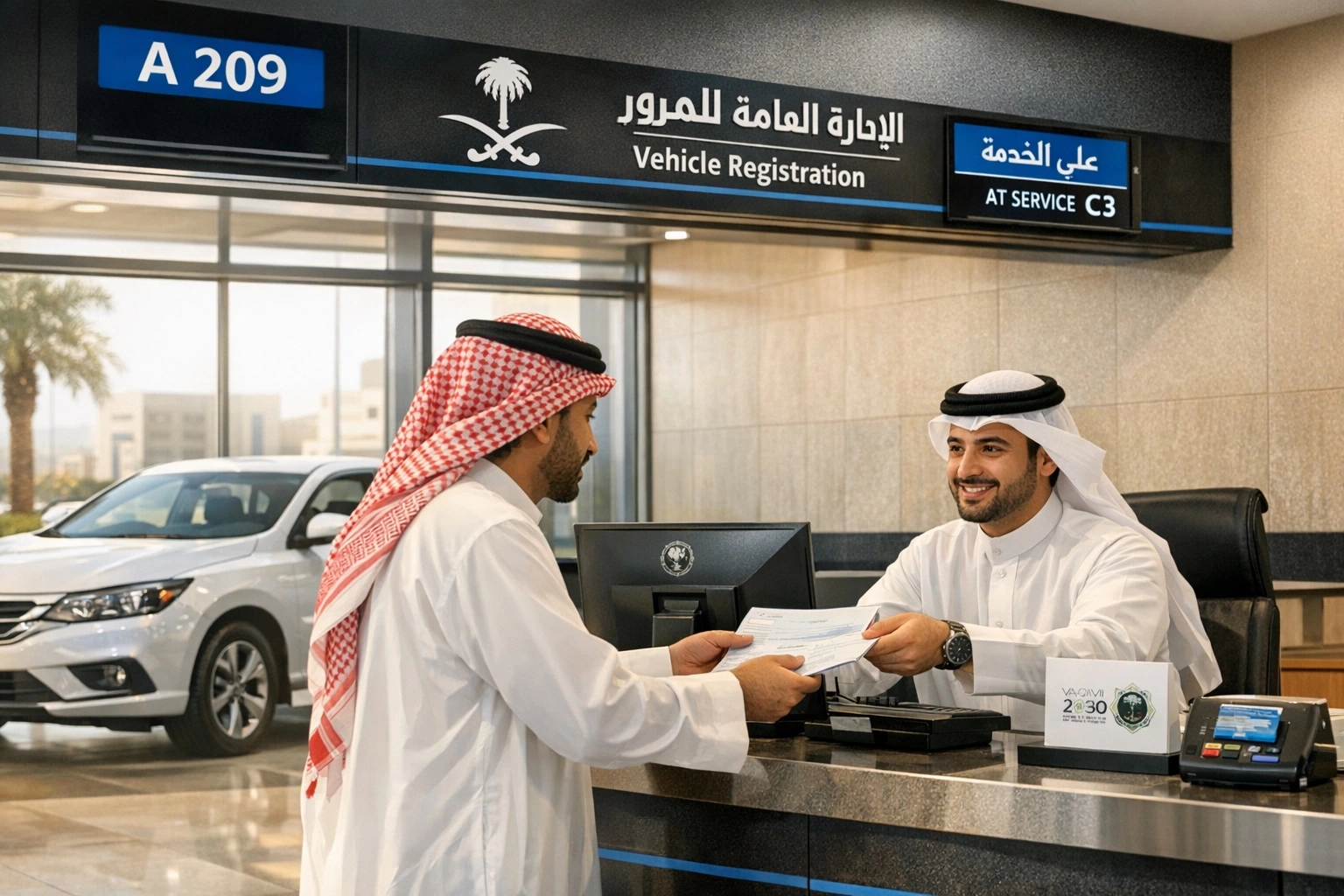
Registering a vehicle in Saudi Arabia is a legal requirement for all car owners, whether you're a citizen, resident, or business owner. The process ensures compliance with safety standards, maintains ownership records, and avoids penalties. Here's a quick overview of what you need to know for 2026:
-
Required Documents: These vary by category (citizens, residents, businesses). Common items include ID, valid insurance, and a technical inspection certificate (if renewing).
-
Fees: Private cars cost SAR 100 annually, while other vehicle types (e.g., trucks, buses) have higher fees. Ownership transfer fees start at SAR 380.
-
Digital Platforms: Most steps, like registration, renewal, and ownership transfer, can be completed online using Absher or Tamm.
-
Penalties: Fines range from SAR 150 to SAR 8,000 for non-compliance, with possible jail time for severe violations.
Whether you're registering a new car, renewing your Istimara, or transferring ownership, following the outlined steps and using digital tools simplifies the process. Keep your documents updated and fees paid to avoid fines or delays.
How to Renew Vehicle Registration in Tamm Saudi Arabia @jsprcreation #ksa #tamm #isthimara
Documents Needed for Vehicle Registration
When registering a vehicle in Saudi Arabia, the documents you'll need vary depending on whether you're a Saudi citizen, an expatriate, or registering under a business name. While the country's digital platforms - Absher for individuals and Tamm for businesses - automatically verify some requirements like insurance and technical inspection status, you'll still need to submit specific paperwork to finalise the process.
For all categories, you must provide a completed vehicle registration form, a customs card for new or imported vehicles, and proof of fee payment through SADAD. Below are the specific requirements based on your category.
Documents for Saudi Citizens
Saudi nationals must present their National ID (Civil Affairs ID) and a valid vehicle insurance policy. If you're registering a used vehicle or renewing your registration, you'll also need a Technical Inspection Certificate (Fahas). Make sure both your insurance and inspection are up to date.
Documents for Expatriates and Residents
Non-Saudi residents are required to provide a copy of their Iqama (Resident Permit) and a valid Saudi Driving Licence. Additionally, a sponsor-certified identification letter from the Chamber of Commerce is necessary. For renewals, you'll need a new sponsor letter and another copy of your driving licence.
Documents for Businesses and Companies
Businesses registering vehicles must submit a copy of their Commercial Registration (CR) certificate, an official company authorisation letter, and the vehicle purchase agreement. Registrations for businesses are handled through Tamm. If the vehicle is for a non-Saudi employee, an identification letter approved by both the sponsor and the Chamber of Commerce is generally required.
It's a good idea to keep digital copies of all your documents. Remember, the system won't allow registration if requirements like insurance or technical inspection aren't up to date.
How to Register Your Vehicle: Step-by-Step
Registering your vehicle in Saudi Arabia has been streamlined through digital platforms, making the process entirely online. The system automatically verifies details like insurance validity and technical inspection status, so there's no need to visit a Traffic Department office unless you want a physical card printed. To get started, you'll need to set up your account on the Tamm platform.
Setting Up Your Tamm Platform Account
To access vehicle registration services, you'll need an account on the Tamm website. Individuals can also use the Absher platform, while businesses can register through the Absher Business portal. Before you begin, ensure your MOI/Absher account is activated. You can do this through your bank, a self-service machine, or at a registration office. Without an active account, you won’t be able to proceed.
"The 'Tamm' aims to support a green environment by saving the value of paper, ink and other stationery besides the traffic officers devoting their time to providing better services." - Maj. Gen. Abdullah Al-Moqbil, Director of Traffic Department
Entering Vehicle and Ownership Information
Once logged in, select the option to "issue a permanent vehicle licence". You'll need to specify your ownership type (individual, business, or other) and input details such as your Customs Card number, plate number, registration type, and vehicle type. The system will also require your driving licence information.
If registering under a company name, additional documents like the Commercial Registration certificate and an authorisation letter from the business owner must be uploaded. Ensure your insurance and technical inspection certificates are up-to-date before proceeding.
Technical Inspection and Safety Certification
A valid Technical Inspection Certificate is essential for all vehicle registrations and renewals. The Absher and Tamm platforms automatically verify this status electronically. For used vehicles or ownership transfers, the car must undergo a physical inspection to ensure it meets safety standards. If your inspection has expired, the system will block your application until it’s renewed. Once your vehicle passes inspection, you can move on to the payment step.
Paying Fees and Receiving Your Istimara
After verifying all information, you’ll need to pay the registration fees through the SADAD payment system or your mobile banking app. For private cars, the annual registration fee is SAR 100. Once payment is complete, your Istimara will be issued electronically as a downloadable PDF.
If you prefer a physical card, you can request delivery via Saudi Post (SPL) through the Absher platform. Be sure to submit your request within 90 days of completing the transaction. Alternatively, you can book an appointment through Absher to have your card printed at a Traffic Department office.
Registration Fees by Vehicle Type
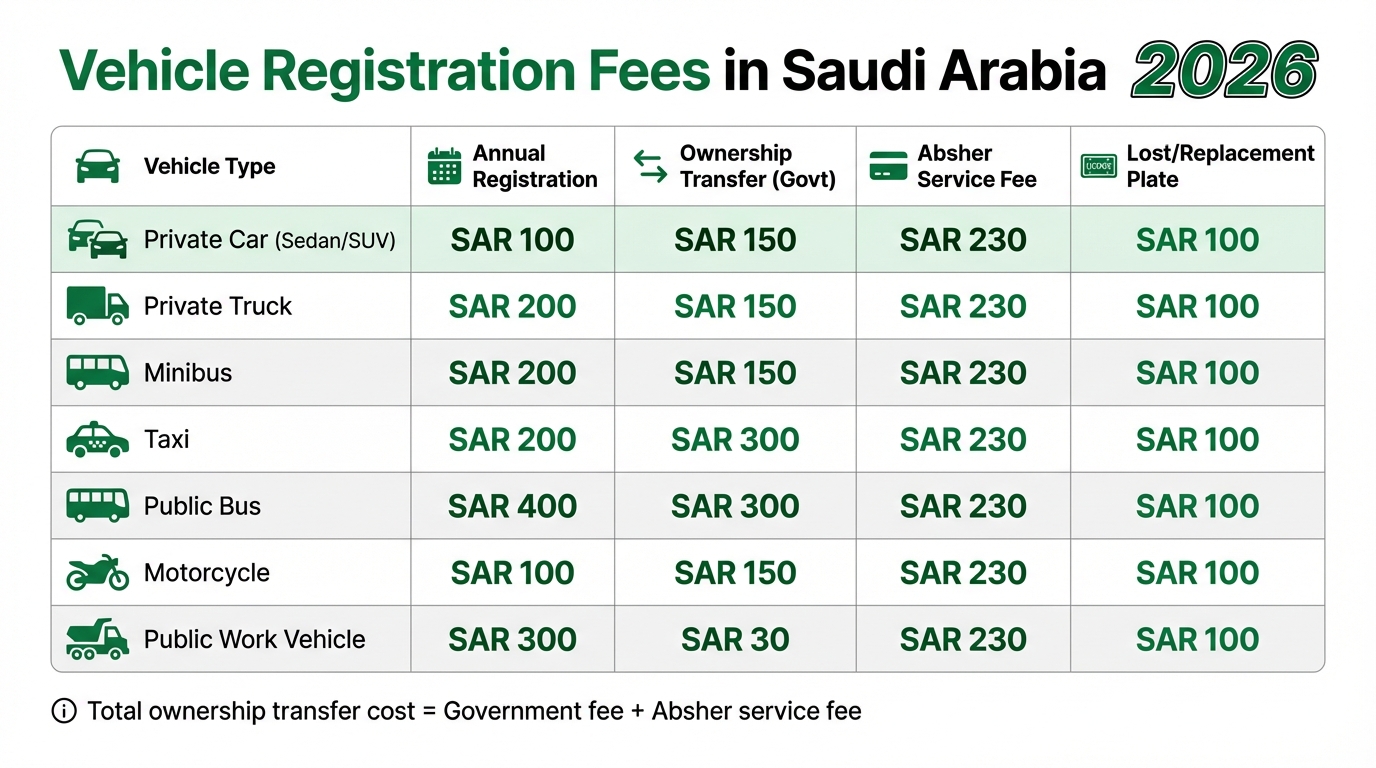
Saudi Arabia Vehicle Registration Fees by Type 2026
When registering your vehicle in Saudi Arabia, it's important to be aware of the fees tied to different vehicle types. This knowledge helps you plan for costs and avoid surprises. The fees depend on whether your vehicle is a private car, a commercial vehicle, or a motorcycle. For instance, private vehicles like sedans and SUVs have the most affordable annual registration fee at SAR 100, while vehicles used for public transportation face steeper charges.
Commercial and public service vehicles come with higher fees. Private trucks and minibuses require SAR 200 annually, the same as taxis, though taxis have higher ownership transfer fees. Public buses and similar transport vehicles incur the highest annual fee at SAR 400, reflecting their heavier road usage. Meanwhile, motorcycles share the same annual fee as private cars: SAR 100.
When transferring ownership, there are two charges: a government fee and an electronic processing fee via the Absher platform. For most private vehicles, the government fee is SAR 150, and the Absher service fee is SAR 230, bringing the total to SAR 380. Taxis have a government transfer fee of SAR 300, while public buses also require SAR 300 for ownership transfers.
Replacing lost or damaged registration plates costs a flat SAR 100 for all vehicle types. However, temporary plates for newly imported vehicles or special cases are priced at a higher SAR 300. All payments can be made through SADAD or MADA-enabled apps.
Here's a quick reference table summarising these fees:
Fee Comparison Table
|
Vehicle Type |
Annual Registration |
Ownership Transfer (Govt) |
Absher Service Fee |
Lost/Replacement Plate |
|---|---|---|---|---|
|
Private Car (Sedan/SUV) |
SAR 100 |
SAR 150 |
SAR 230 |
SAR 100 |
|
Private Truck |
SAR 200 |
SAR 150 |
SAR 230 |
SAR 100 |
|
Minibus |
SAR 200 |
SAR 150 |
SAR 230 |
SAR 100 |
|
Taxi |
SAR 200 |
SAR 300 |
SAR 230 |
SAR 100 |
|
Public Bus |
SAR 400 |
SAR 300 |
SAR 230 |
SAR 100 |
|
Motorcycle |
SAR 100 |
SAR 150 |
SAR 230 |
SAR 100 |
|
Public Work Vehicle |
SAR 300 |
SAR 30 |
SAR 230 |
SAR 100 |
Renewal, Ownership Transfer, and Replacement Procedures
Just like vehicle registration, tasks like ownership transfers and card replacements are now streamlined online, offering a smooth and efficient process through digital verification tools.
How to Renew via Absher or Tamm
You can easily renew your vehicle registration online using Absher or Tamm, without the need to visit a government office. However, make sure your vehicle meets all the necessary requirements - inspection, valid insurance, and no outstanding violations. If anything is missing, the system will block the renewal process.
Here’s how to do it:
-
Log in to Absher and go to the "Vehicles" section.
-
Select "Manage Vehicles" and choose the vehicle you want to renew.
-
Click on "Renew Vehicle Registration." The system will check your eligibility based on inspection results, insurance status, and fee payment.
-
Once all requirements are met, click "Confirm Renewal" to finalise the process.
After completing the renewal, you can view or print your digital Istimara directly from the Absher dashboard under "Vehicle Details." To keep track of your registration’s expiration date, use the "My Vehicles" service.
Now that your registration is renewed, let’s look at how you can transfer vehicle ownership.
Transferring Vehicle Ownership
Transferring ownership is equally simple and can be done entirely online. Both the seller and buyer need to be registered on Absher. The process starts with the seller entering the buyer's details and sale information.
The buyer then has one hour to accept the transfer request. After that, the buyer must secure new insurance under their name and pay the required fees via Absher’s secure payment system. The total cost for the transfer is SAR 380, which includes a SAR 150 government fee and a SAR 230 service fee. Keep in mind, this service is typically available for private vehicles and is open to both residents and expatriates.
Replacing Lost or Damaged Istimara Cards
If your Istimara card is lost or damaged, you can request a replacement via Absher. Before doing so, ensure that all fines are paid. The replacement fee is SAR 100.
To request a replacement:
-
Log in to Absher and go to "My Vehicles."
-
Select your vehicle and choose "Vehicle Registration" to request the replacement. You can also save or print a digital copy instantly.
For replacing a physical plate, you’ll need to file a police report first, which can also be done through Absher.
Fines and Penalties for Non-Compliance
Following Saudi Arabia's vehicle registration rules is not just a formality - it’s essential to avoid hefty fines and even potential jail time. For example, driving with an expired Istimara (vehicle registration) can result in a fine of SAR 300, although you do get a 30-day grace period after the expiry date before this penalty kicks in. On the other hand, driving without an Istimara entirely can lead to fines ranging between SAR 500 and SAR 900.
The consequences don’t stop at financial penalties. Operating a vehicle with an expired or invalid registration could also result in imprisonment for 10 to 15 days, either alongside or instead of a fine.
Technical compliance is just as important. Without a valid Technical Inspection Certificate, renewing your Istimara becomes impossible. Driving without this certificate can also lead to fines between SAR 150 and SAR 500.
To steer clear of these penalties, it’s a good idea to set reminders for your Istimara's expiration date and schedule your technical inspection in advance. The Absher platform makes life easier by allowing you to renew your registration up to 180 days before it expires. Also, ensure any outstanding traffic violations are cleared promptly to avoid delays in the renewal process.
Registering Imported Vehicles
Bringing imported vehicles into the UAE involves a few extra steps compared to registering domestic ones, starting with customs clearance through ZATCA. Imported vehicles must also align with international shipping regulations and technical standards.
Before shipping your vehicle, ensure it meets SASO technical specifications. You’ll need to acquire a conformity certificate through the SASO e-services portal. This certificate confirms the vehicle complies with the required standards.
Once customs clearance is complete, the next step is obtaining a Technical Inspection Certificate. You’ll also need to submit identification documents - either a Civil Affairs ID for UAE nationals or a residency ID for expatriates - along with the necessary traffic forms.
The registration fees for imported vehicles are the same as for local ones. Private vehicles and motorbikes require a fee of SAR 100, while private trucks are SAR 200. If you need export plates, there’s an additional fee of SAR 100.
For businesses importing commercial vehicles, an approval letter from the Ministry of Transport is mandatory, depending on the type of vehicle being imported. After meeting all customs and inspection requirements, you can manage the vehicle’s records through platforms like Absher or Tamm. These steps integrate seamlessly with the standard online registration process outlined earlier.
Key Takeaways
The vehicle registration process in Saudi Arabia demands accurate documentation, meeting deadlines, and completing transactions through digital platforms. Key requirements include a Civil Affairs ID for citizens, a Resident Permit and sponsor letter for expatriates, and a valid Technical Inspection Certificate.
Staying on top of deadlines is crucial to avoid penalties. Driving with expired registration can result in fines ranging from SAR 150 to SAR 500, or even imprisonment for 10 to 15 days. Additionally, failing to transfer vehicle ownership can lead to fines of SAR 1,500 for the first offence, SAR 3,000 for the second, and SAR 8,000 for the third.
Here’s a breakdown of the fees:
-
Registration fees: SAR 100 annually for private cars and motorcycles, SAR 200 for private trucks and minibuses, and SAR 400 for public buses.
-
Ownership transfer fees: SAR 150 for private vehicles, SAR 300 for taxis and public vehicles, plus an Absher service fee of SAR 230.
To keep your records updated and avoid complications, settle fees promptly through SADAD or Mada. Maintaining valid technical inspection and insurance also ensures smoother renewals and transfers in the future.
FAQs
What are the fines for driving with an expired vehicle registration in Saudi Arabia?
Driving in Saudi Arabia with an expired vehicle registration can result in fines ranging from SAR 500 to SAR 900. In some instances, authorities may even impound the vehicle. If the registration remains expired for over 60 days, you could face an extra fine of up to SAR 300.
To steer clear of these penalties, make sure to renew your vehicle registration promptly and keep valid documents with you whenever you're on the road.
How can expatriates register their vehicles online in Saudi Arabia using the Absher platform?
Expatriates living in Saudi Arabia can now register their vehicles online with ease, thanks to the Absher e-government portal. There’s no need to visit a traffic office in person. All you need is your Resident Permit (Iqama) number and password to log in. Once inside, navigate to “Vehicles” → “Manage Vehicles”, select the vehicle you want to register, and choose either “Register Vehicle” or “Renew Vehicle Registration”, depending on your needs.
To complete the process, you’ll need to upload some key documents. These include a copy of your Resident Permit (Iqama), an identification letter from your sponsor, and, if registering under a company, additional paperwork like a commercial record. After verifying details such as the customs card number and chassis number, you can pay the registration fee online using a Saudi Riyal (SAR) payment card. Once the payment is processed, an electronic registration certificate will be generated. You can download or print this certificate for your records. If required, you can also request new licence plates through the same portal.
The best part? This service is available round the clock, making it a seamless and time-saving option for expatriates.
What documents are required for businesses to register a vehicle in Saudi Arabia?
To register a vehicle under a business name in Saudi Arabia, you'll need to gather and submit several key documents. Here's what you'll need:
-
A completed and signed vehicle registration form.
-
The vehicle's customs clearance certificate.
-
A receipt for the payment of applicable fees.
-
A copy of the national ID (for Saudi citizens) or residency permit (for non-Saudis).
-
An official letter from the vehicle owner addressed to the relevant authority, requesting registration under the business name.
-
A certified introduction letter from the sponsor and the commercial entity, attested by the Chamber of Commerce (required for non-Saudis).
-
A copy of the commercial registration certificate of the company or establishment.
All these documents must be submitted through the Ministry of Interior's electronic platforms, such as Tamm, or other authorised channels. For transport companies, a valid transport licence and vehicle operation card may be sufficient, potentially bypassing the need for additional approvals from the Ministry of Transport.
Looking for a used car in KSA or new car deals? Explore YallaMotor’s verified listings today.